

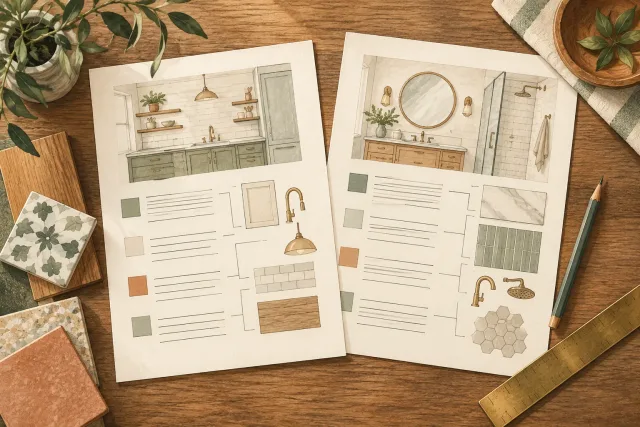
Conceptual scene for this article. Editorial illustration; not a documented local project or an installation specification.
Three remodeling estimates can describe three different projects, even when every contractor has visited the same room. One includes painting, another assumes you will handle it, and a third carries an allowance for fixtures you have not selected. Comparing only the totals hides those differences.
For Lehigh Valley homeowners preparing a fall project, the useful first step is a common scope. It gives contractors the same starting point and makes their recommendations easier to evaluate without asking everyone to design an identical solution.
Give every bidder the same brief
Prepare a short description of the problem, the area of work, the functions you need and the finishes you have already chosen. Include drawings and product model numbers when available. Identify which decisions are open and which parts of the home must remain usable.
Send later clarifications to every contractor still preparing a proposal. If your layout or selection changes, ask for a revised estimate rather than comparing a new scope with an older one. Keep the date and version on each document.
Build a scope comparison
Use one row for each major task: demolition, structural work, utilities, cabinetry or fixtures, finishes, protection, cleanup and restoration. Add columns for the proposed product, quantity, labor, exclusions and unresolved questions. Write “not stated” when information is missing rather than assuming it is included.
Ask about work just beyond the main room. Who repairs a ceiling opened for plumbing? Who removes packaging or restores landscaping? A scope comparison is most useful when it captures those edges, where homeowners and contractors can otherwise hold different expectations.
Separate allowances from selections
An allowance leaves something to be resolved later. Ask what the amount covers, how tax and installation are treated, and what happens if the selected item costs more or less. Compare the same selected product wherever possible. For an unselected item, record the assumption explicitly.
Request a written list of exclusions and concealed conditions that cannot be priced with confidence yet. Ask how the contractor will document and price additional work. An estimate can be detailed while still recognizing uncertainty; the important part is understanding how that uncertainty will be handled.
Check the business and contract details
Pennsylvania’s contractor-registration FAQ explains the state's registration framework. Check the applicable registration record and ask for relevant insurance information. Treat registration as a record to verify, not as a state endorsement of workmanship or a substitute for references and project experience.
The Pennsylvania Attorney General’s home-improvement consumer guide is a useful reference for covered contracts. Review the written scope, payment terms, approximate timing and required consumer information before signing. For a question about your specific legal rights, consult the current official guidance or a qualified adviser.
Compare the working relationship too
Ask who manages the site, how frequently you will receive updates and who can approve changes. Discuss scheduling assumptions, access to the property and how delays are communicated. Speak with references about projects comparable in scope to yours and ask how the contractor handled questions after work began.
Choose with the complete project in view: a scope you understand, reasonable answers to open questions and a process you can work with. Our contractor walkthrough guide can help you prepare that first brief. Use the YHR directory as a starting point for finding relevant local businesses to interview.